Why the A-frame kicks out at the knee
A classic A-frame wastes its edges. Ours bends the wall outward at the knee, and that one move is where every other decision comes from.
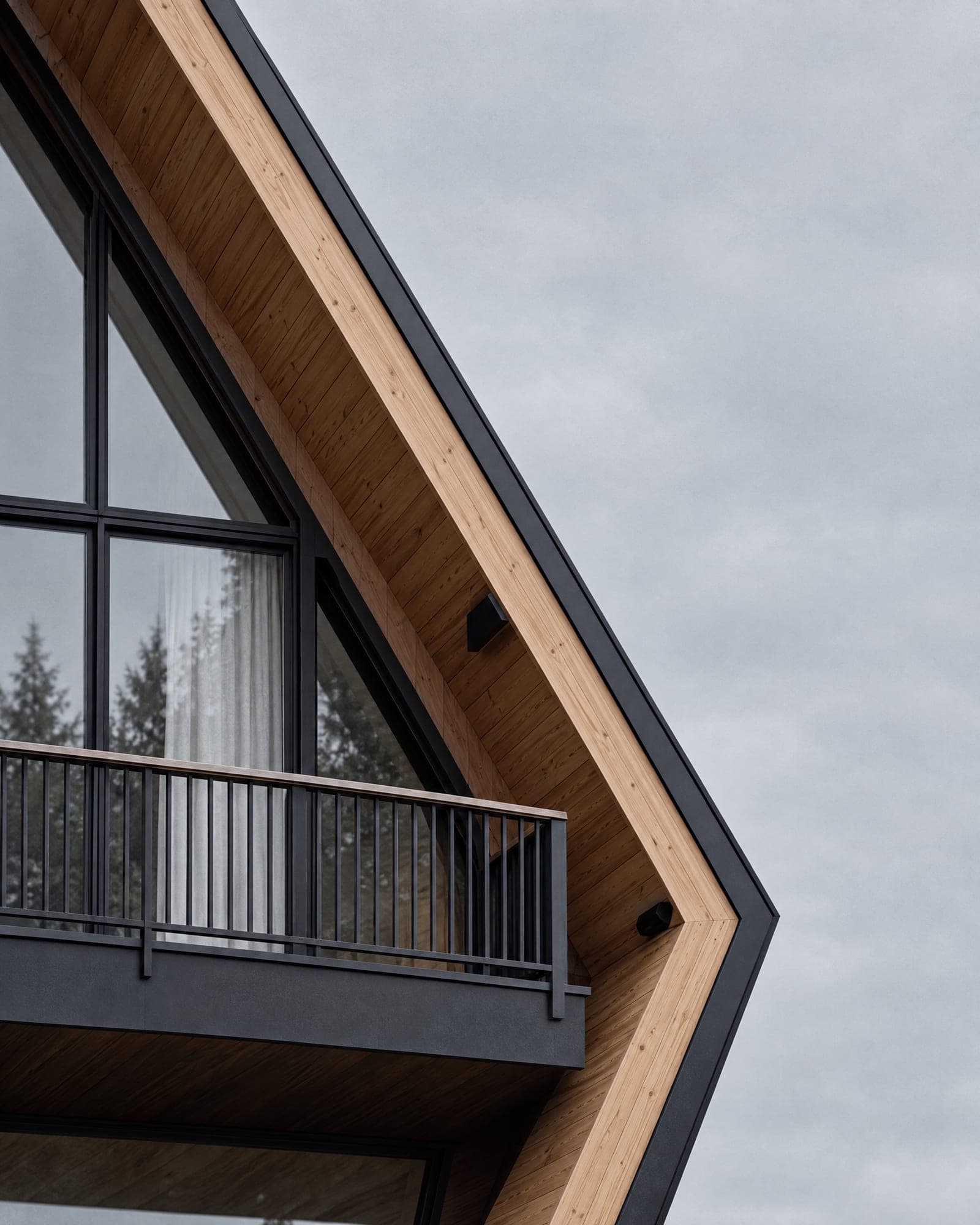
A traditional A-frame is a triangle sitting on the ground. It is cheap to build and beautiful from the outside, and inside it is a room whose walls start at your ankles. The first few feet of floor on each side are good for a bookshelf and not much else.
The AFRME profile answers that with one move. The roof runs down from the ridge as it always has, but at roughly a third of the height it turns and leans back inward to the base. The walls at floor level stand almost upright, so a bed or a sofa sits against them. The widest point of the house is now above head height, at the knee, which is exactly where a second floor wants to be.
That is why the second floor of a Two is the biggest room in the house, and why the balcony sits where it does: the knee is the natural line for a floor, and a floor that ends at the glass wants a rail.
Structurally the profile is a portal frame. Each frame is a single pentagon of laminated timber with steel plates at the knee and the ridge. The frames carry the roof and the floors to the ground without any internal load-bearing walls, so layouts can change from one build to the next without touching the structure.
Because the shape is fixed, it scales. A Studio and a Four are the same drawing at different sizes; the angles, the reveal, the proportion of glass to metal are identical. From across a valley they read as the same house. That consistency is the brand, but it is also what makes the AFRME System™ possible: one set of details, tested once, cut on the same machines at five scales.